
When a company plans to increase productivity and consistently produce parts with the same level of quality, sooner or later it faces the challenge of selecting modern metalworking equipment. This is when many manufacturers begin to look into what a CNC machine is, how it differs from conventional equipment, and why this technology has become an industry standard.
Automation reduces the number of manual operations, improves machining repeatability, and makes the production process more stable and predictable.
What is a CNC machine and how does it work?
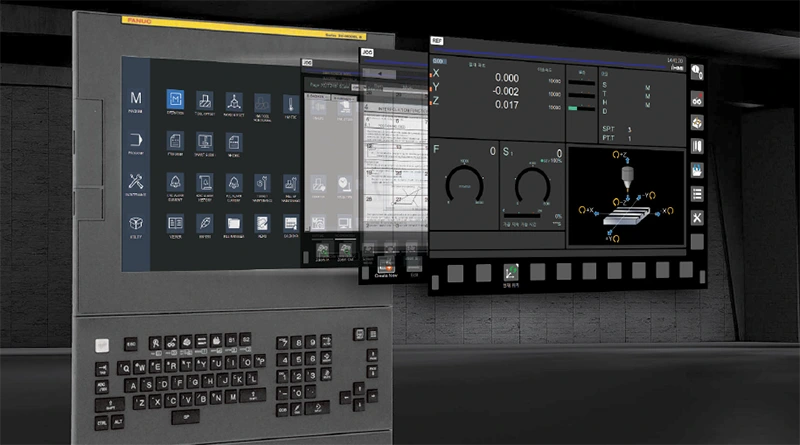
First, it is important to understand what CNC means. The abbreviation stands for Computer Numerical Control — a system that controls machine operation according to a pre-prepared program. The control program defines movements, feed rates, spindle operating modes, and the sequence of technological commands. The CNC system interprets these commands and controls axis movements, spindle operation, tool changes, and auxiliary machine functions provided by the machine design.
In essence, a CNC machine processes a workpiece automatically according to a predefined program. The system calculates and coordinates the movements of the machine’s actuating units and ensures repeatable execution of the programmed cycle.
The operation of this type of equipment is based on the interaction of several systems. The main ones include:
- the machine bed, guideways, and other structural elements that provide the required rigidity and stability;
- the spindle unit and cutting tool, which are directly involved in the material removal process;
- servo drives and feedback systems that provide accurate movement of the machine’s moving components along the programmed coordinates;
- the CNC system and auxiliary automation, which execute the control program, coordinate the machine’s actuating mechanisms, and control the technological functions provided by the machine design.
It is the coordinated operation of the mechanical structure, drives, control system, cutting tools, and tooling that makes it possible to achieve the required machining accuracy, repeatability, and productivity.
What are CNC machines used for?
Modern manufacturing places high demands not only on product quality but also on production speed and lead times. For this reason, programmable equipment is widely used wherever high process repeatability is required.
CNC machines are used to manufacture parts for mechanical engineering, the automotive industry, power generation, aerospace, instrumentation, tooling production, and many other sectors. Depending on the application, the equipment can perform milling, turning, drilling, boring, threading, and complex machining in a single setup.
The advantages of automated machining are particularly noticeable in repetitive operations and series production. Once the machine has been set up and the program started, the main operations of the working cycle are performed automatically. The CNC system controls axis movements, spindle operation, and the technological functions specified in the control program, reducing the number of manual actions and limiting the influence of human factors.
Main types of CNC machines
Although the general principle of programmed control remains the same, different types of CNC machines are designed for different technological tasks. Equipment selection is determined primarily by part geometry, the type of operations to be performed, workpiece material, and productivity requirements.
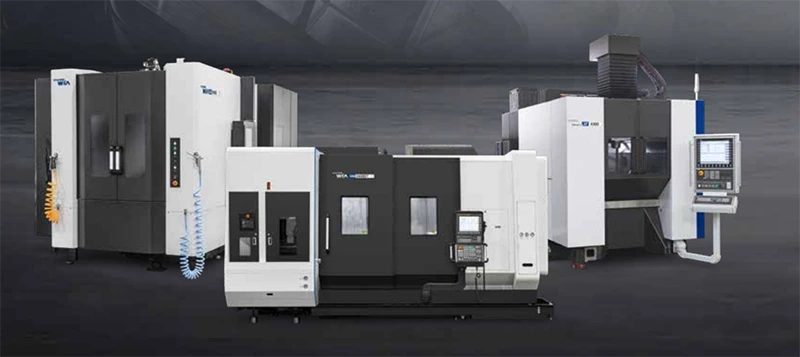
The most common types of CNC equipment include:
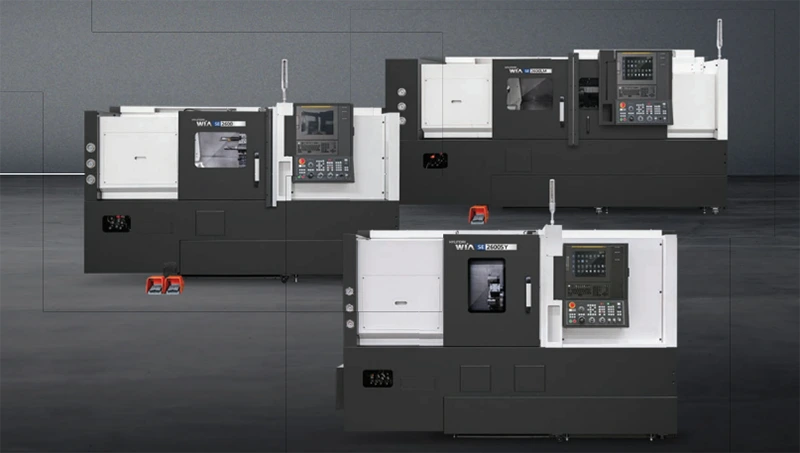
- turning machines for machining rotational parts;
- vertical machining centers (VMC);
- horizontal machining centers (HMC);
- vertical turning centers for machining large-diameter and heavy workpieces;
- drilling and milling centers that combine several machining operations;
- 5-axis machining centers for producing parts with complex geometries.
Compact CNC machines deserve special attention. They are designed primarily for industrial machining of small and medium-sized parts and help make efficient use of production floor space. Their compact dimensions make it possible to organize the working area efficiently while retaining the capabilities required for the corresponding production tasks.
Why companies switch to CNC equipment
The main advantage of CNC equipment is not limited to automation. This technology helps make the production process more stable, accurate, and economically efficient.
The most important advantages include:
- high machining accuracy and stable repeatability of results;
- the ability to perform complex technological operations while reducing the number of manual changeovers;
- higher productivity and shorter execution times for repetitive production cycles;
- a lower probability of errors and scrap due to fewer manual operations and consistent repetition of a properly configured machining cycle;
- convenient integration with CAD/CAM systems and other digital manufacturing tools.
Another important advantage is production flexibility. When switching to a different part, the control program can be replaced or adjusted quickly. This is particularly important for companies that work with a wide range of orders or regularly update their product portfolio.
What to consider when choosing a CNC machine
Even machines within the same class can differ significantly in their capabilities. When selecting equipment, it is important to consider not only the purchase price but also the requirements of future operation.
In practice, particular attention should be paid to several criteria: the working envelope, spindle characteristics, structural rigidity, control system, automation capabilities, service support, and how well the machine matches the specific production task. It is equally important to understand which machining operations will be performed most often and what requirements are placed on the quality of the finished part.
This is why machine selection should begin not with a catalogue of available models but with an analysis of the technological process. This approach makes it possible to select equipment that best matches the company’s production requirements, provides stable machining performance, high productivity, and reliable operation over many years.