
A CNC controller is a key component of the control system of a modern metalworking machine tool. It executes the control program, calculates and coordinates axis movements, sets spindle operating modes, and controls the auxiliary functions provided by the machine design. The controller's capabilities determine how effectively the control system can utilize the machine's mechanical design, support complex machining cycles, automation, diagnostics, and interaction with other production equipment.
How a CNC controller works
During machine operation, the CNC system executes the control program and converts its commands into coordinated actions of the machine's actuating mechanisms. The controller calculates axis trajectories and motion parameters, controls spindle operation, processes feedback signals, and ensures that the technological sequence defined by the program is carried out.
Depending on the machine design and configuration, the CNC system may control:
- servo drives and coordinate axes;
- the main spindle and additional spindles;
- a turret or automatic tool changing system;
- coolant supply;
- tool and workpiece measurement systems;
- pallet systems, loading devices, and other automation equipment.
The controller does not operate in isolation. To perform the required movements, it interacts with servo drives and feedback systems, receives information about the condition of the equipment, and processes signals from sensors and actuating devices provided by the machine design.
CNC system capabilities are especially important when performing complex machining cycles. The selected platform determines the number of supported and simultaneously controlled axes, interpolation capabilities, built-in machining functions, diagnostic, measurement and automation tools, as well as methods for transferring programs and exchanging data with other production systems.
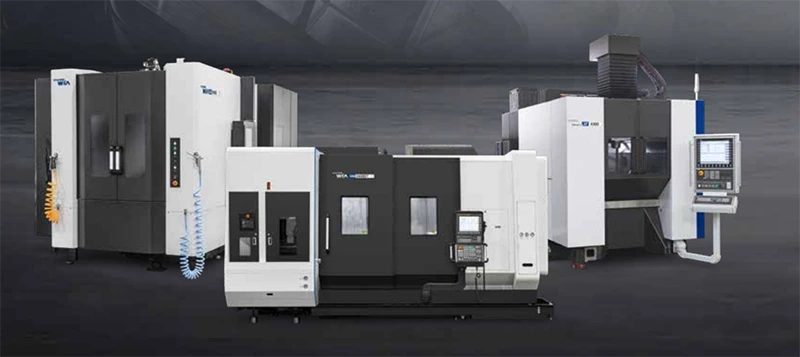
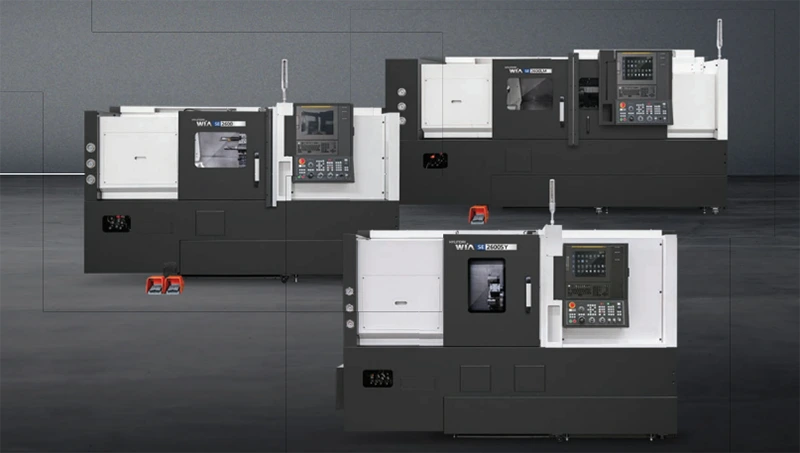
These requirements apply to machines of any class. For example, compact turning machines from WIA Machine Tools also use full-featured industrial CNC systems because accurate program execution and coordinated operation of drives, the spindle and auxiliary mechanisms are required regardless of machine size.
Tasks and role of the CNC system
Machining process control
After the program is started, the CNC system interprets its commands and generates instructions for the machine's actuating systems. The controller calculates axis trajectories and motion parameters, controls spindle speed and operating modes, and synchronizes movements with tool-change commands and other machining functions.
Control system performance is especially important in complex multi-axis machining, where several axes must operate in coordination while maintaining the required tool path. This is relevant for turn-mill machines and 5-axis milling machines, where individual movements must be performed as a single coordinated machining process.
Machine condition monitoring and diagnostics
During operation, the control system receives signals from servo drives, sensors, and other devices provided by the machine design. These data are used to monitor the position of controlled axes, the condition of actuating mechanisms, and the operation of auxiliary systems.
If a malfunction occurs or a monitored parameter exceeds the permitted limits, the system may generate a warning or alarm message, prevent a specific operation from being performed, or stop the machining cycle. The exact response depends on the particular signal, machine design, and control logic implemented by the manufacturer.
Additional measurement systems extend these capabilities. Tool measurement, for example, can be used to monitor tool condition and adjust compensation values, while a workpiece probe can determine the actual position of the workpiece and refine the working coordinate system. These functions are available only when the machine is equipped with the corresponding hardware and properly configured software.
Operator interaction and automation
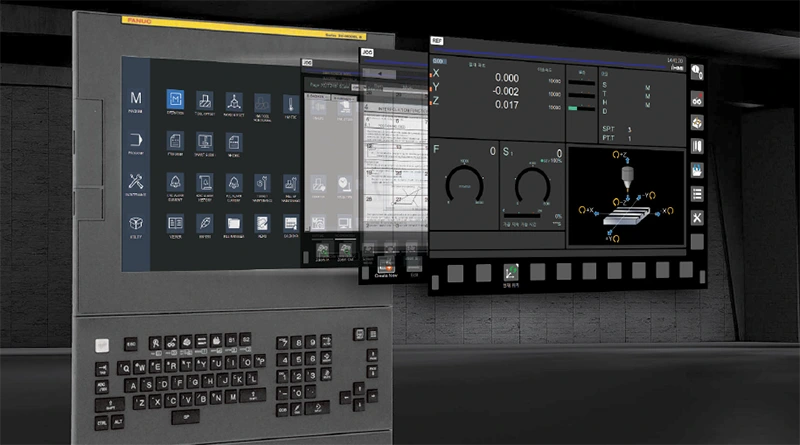
The CNC interface is the operator's primary means of interacting with the machine. It is used to select and start control programs, enter machining parameters and corrections, set work coordinates, perform manual movements, monitor machine status, and view diagnostic messages.
The CNC system also plays an important role in production automation. Depending on the machine configuration, it can interact with bar feeders, automatic part loading and unloading systems, robots, pallet systems, measurement equipment, and other external devices.
Modern control systems can also transfer control programs and exchange production data with external software and information systems. This makes it possible to integrate the machine into more complex automated manufacturing processes.
Which CNC systems are used on WIA Machine Tools machines
Depending on the model and configuration, WIA Machine Tools machines use CNC systems from FANUC, Siemens, and HEIDENHAIN. FANUC is the main platform used on most WIA equipment, while other control systems are available for selected multi-axis machining centers.
FANUC
FANUC CNC systems are installed on most WIA Machine Tools turning machines and machining centers. They are used together with the proprietary WIA FANUC Smart Plus package, which complements standard FANUC capabilities with programming, diagnostics, machine condition monitoring, and other functions adapted to specific machine series.
Different CNC families are used depending on the type of equipment:
- FANUC 0i-TF Plus — used primarily on WIA turning machines, including the E160, SE2200, and HD2600 series.
- FANUC 0i-MF Plus — used on vertical and horizontal machining centers, including machines such as the i-CUT4000, KF4600 II, and KF6700 II.
- FANUC 30i/31i/32i — used on equipment with more complex kinematics and advanced control requirements. FANUC 32i-B, for example, is used on KL7000 and L800 turning machines and LV-series vertical turning centers; FANUC 31i-B Plus is used on HS10000 and KH1000 horizontal machining centers; and FANUC 31i-B5 Plus is used on XM2600 and KF-5A 5-axis machines.
The specific FANUC platform is therefore selected by the manufacturer according to the machine design, the number of controlled axes, and the functional capabilities required for a particular model.
Siemens SINUMERIK ONE
Siemens SINUMERIK ONE is available for selected WIA 5-axis machining centers. It is designed for complex multi-axis machining and provides the functions required to control simultaneous movements of multiple linear and rotary axes. SINUMERIK ONE is available for selected configurations of the WIA XF6300 and XF8500 5-axis machining centers.
HEIDENHAIN TNC640
HEIDENHAIN TNC640 is also offered for selected XF6300 and XF8500 configurations. It is designed for milling and multi-axis machining and supports the functions required to work with complex three-dimensional tool paths and simultaneously control several axes.
The specific CNC system and available functions depend on the model, version, and configuration of the WIA Machine Tools machine.
Equipment selection and technical support
When selecting equipment, the CNC system should be considered as part of the specific machine configuration rather than as a separate component. Selection begins with the machining task: the geometry and material of the parts, required operations, accuracy requirements, planned production capacity, and level of automation. Based on these data, the appropriate WIA Machine Tools model, configuration, and control system can be determined.
For accurate equipment selection, it is advisable to provide drawings or 3D models of the parts, information about the workpiece material, required accuracy, production volume, and a list of the main operations. This makes it possible to evaluate not only the capabilities of the machine itself but also the required additional equipment, measurement systems, and automation solutions.
Technical support after equipment delivery is equally important. TECHNICAL CLUSTER LLC, the official representative of WIA Machine Tools in Ukraine, provides project support from technical consultation and equipment selection through delivery, commissioning, personnel training, warranty service, and post-warranty maintenance.