

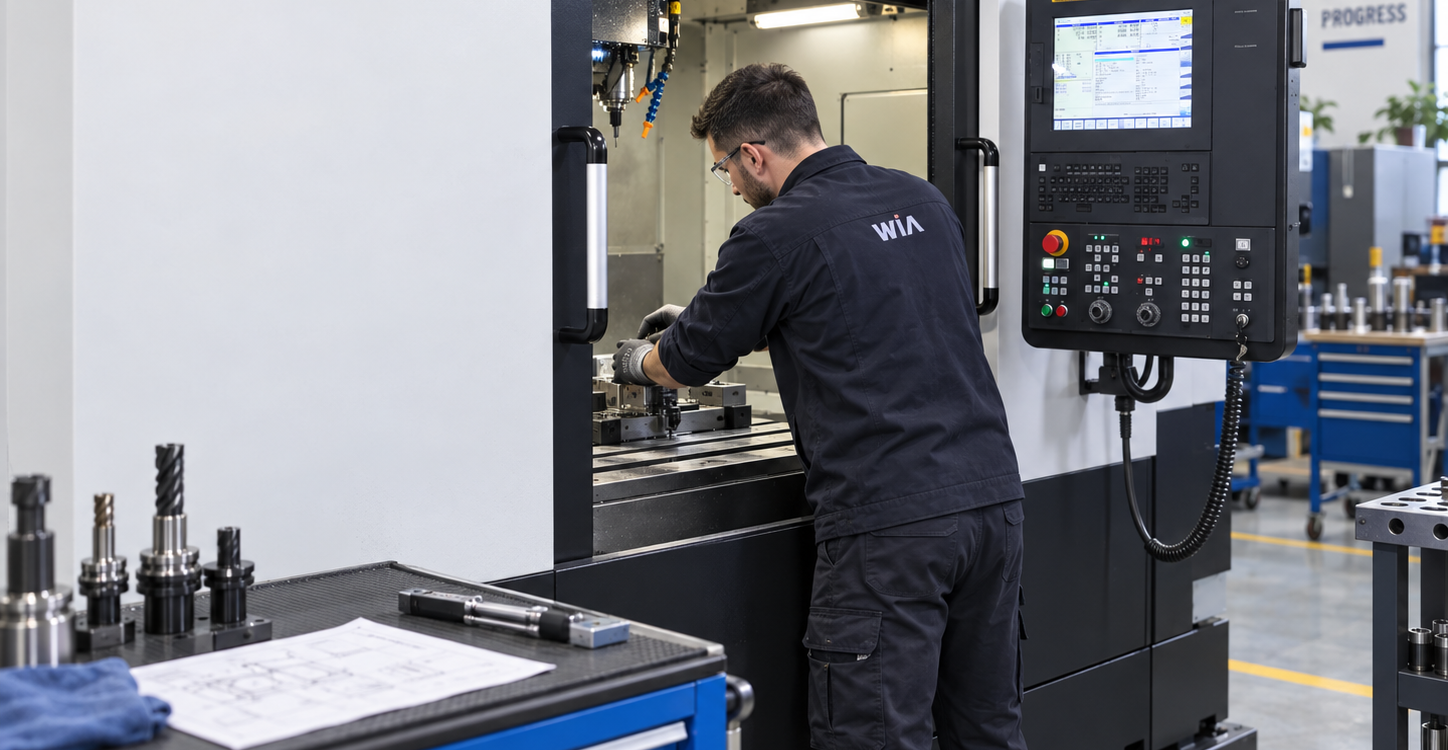
Preparation of computer numerical control equipment begins before the first acceptable part is produced. Tooling and cutting tools must be installed, work offsets set, machine movements checked, a trial cycle performed, and the result verified against the drawing and technological requirements. The setup technician provides the connection between technical documentation and the actual machining process on the machine.
A CNC machine setup technician is a technical specialist who prepares equipment for manufacturing a specific part or batch and ensures stable execution of the required technological cycle. Their work lies at the intersection of cutting technology, machine mechanics, control systems, and measurement. Setup time, first-part quality, machining accuracy, and the stability of subsequent production all depend on the technician's qualifications.
What is the difference between a CNC setup technician and an operator?
The division of responsibilities may vary from one company to another. In a typical arrangement, the setup technician prepares the machine for a new part or production batch, while the operator works on already configured equipment: loading and unloading workpieces, starting the cycle, monitoring machining, and checking product quality within their area of responsibility.
A setup technician must understand the relationship between the drawing, the technological process, and the machining program. They check tools, fixtures, and workpiece location, set work coordinate systems and offsets, use measuring equipment, monitor machine behavior during trial runs, and make permitted adjustments. Knowledge of basic mechanics and electronics helps with initial diagnostics, but repairs of complex electronic, electrical, and mechanical units are the responsibility of service personnel.
The scope and complexity of setup depend on the machine design, part geometry, and manufacturing process. Preparing a basic two-axis lathe is usually simpler than setting up a turn-mill center with driven tooling, a sub-spindle, and additional axes. However, even relatively simple equipment may require a high level of skill when tight tolerances, complex workholding, or non-standard tooling are involved.
What does a setup technician do before producing a new part?
The first stage involves studying the drawing, the technological process, the tooling list, and the machining program. Preparation includes checking fixtures, cutting tools, inserts, and holders, as well as verifying that the raw workpiece meets the requirements of the process documentation.
Next, tool assemblies are prepared and assembled, cutting tools are installed, and machine fixtures are configured. On turning equipment, depending on the task, a chuck, collet clamping device, and suitable jaws may be used, while the tailstock or steady rest is adjusted when required. On a machining center, the workpiece may be clamped in a vise, on fixture plates, or in dedicated workholding devices. Fixture installation must provide rigid and reliable clamping of the workpiece while also allowing safe movement of the machine's moving units.
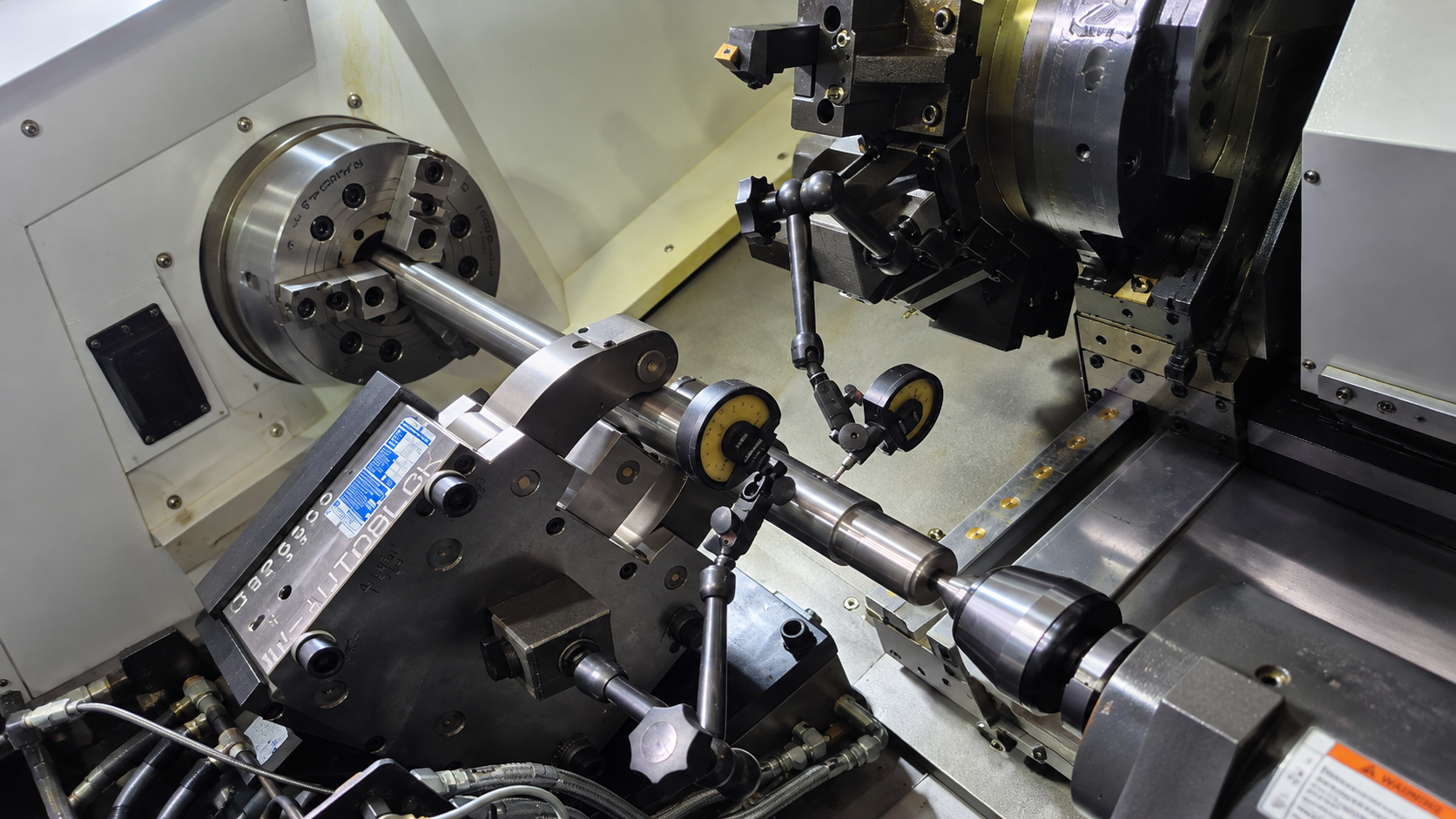
The next stage is tool setup and entry of offsets. On milling machines, tool length and diameter or radius are defined, while on turning machines the tool's geometric position and the necessary cutting-edge parameters are set. Measurements can be performed directly on the machine or outside the working area. A presetter may be used for off-machine tool measurement if such equipment is available in the workshop. The measured values are entered into the corresponding CNC offset tables.
After the workpiece is installed and located, the position of the work zero is determined and the corresponding work coordinate system is set. The setup technician checks the correctness of the work offset, tool start positions, and safe movement points. An error at this stage may shift the entire machining trajectory or cause a collision between the tool, workpiece, or fixture, so work coordinates are verified before cutting begins.
Duties of a CNC setup technician when preparing the first part
The exact list of tasks depends on machine design, part complexity, and how responsibilities are distributed within the company. A typical setup cycle includes:
- reading the drawing and technological documentation;
- checking workpiece material and dimensions;
- checking and, when necessary, selecting cutting tools according to the process;
- installing fixtures and verifying correct workpiece location;
- entering tool offsets and setting the work coordinate system;
- loading the machining program into CNC memory;
- checking the program and safe machine movements before cutting;
- producing the first part and checking critical dimensions;
- making the necessary adjustments based on trial machining results;
- transferring the verified process to serial production.
This sequence helps identify errors and inconsistencies before an entire batch is produced. The setup technician's task is not only to start the machine, but also to confirm that the equipment performs the required technological process accurately, safely, and consistently.
Duties of a CNC machine setup technician during a trial cycle
During a trial run, the main tasks of the setup technician are related to verifying the safety and correctness of the machining program before the process is transferred to serial production. Depending on the CNC system, graphical simulation, step-by-step program execution (Single Block), rapid-movement override, and other safe verification modes may be used.
The technician checks the tool-change sequence, approach to the workpiece, exit from the cutting zone, spindle operation, axis movements, and execution of auxiliary commands. If inconsistencies are found, the technician may adjust work coordinates, tool offsets, or the machining program within the limits of their authority.
After trial machining, critical dimensions of the first part are checked. If necessary, geometric or wear offsets are corrected, while cutting parameters may be adjusted in the event of vibration, unstable chip formation, or excessive load. Once machining accuracy and process stability are confirmed, the setup is considered complete and the equipment is transferred to serial production.
How does the setup technician's work change on different machines?
The basic setup principles remain the same, but practical actions depend on machine configuration, the number of controlled axes, and installed equipment. On turning machines, particular attention is paid to the correct position of the cutting tool relative to the spindle axis, reliable clamping of the workpiece in the chuck or another clamping device, tool overhang, and safe operation of the turret. If a tailstock, steady rest, driven tooling, or additional axes are used, more parameters must be checked before startup.
On a vertical machining center, important factors include workpiece location on the table, fixture position, tool length, and safe clearance heights. Vertical CNC machines are used for milling, drilling, and boring operations, so the setup technician works with different clamping arrangements and tooling combinations.
On a horizontal machining center, the orientation of the workpiece on the pallet, operation of the rotary table, and access to multiple sides of the part in a single setup must be considered. For horizontal CNC machining centers, correct setup of work coordinate systems for different machining sides and verification of safe movements during pallet rotation are especially important.
On a turn-mill center, the technician must take into account the coordinated operation of the spindle, driven tooling, C-axis and, depending on the configuration, the Y-axis, sub-spindle, and other additional units. The more operations and controlled movements are combined in one machine, the greater the requirements for checking offsets, machine sequence, and safe movements.
What knowledge and skills does a setup technician need?
A highly qualified setup technician is not limited to operating the CNC control. They must understand the technological logic of the operation and be able to identify possible causes of deviations: why a dimension approaches a tolerance limit after setup, why vibration appears, why surface quality deteriorates, or why a cutting edge begins to wear quickly.
For confident work, the following skills and knowledge are required:
- reading engineering drawings, tolerance designations, and surface requirements;
- understanding the fundamentals of metal cutting and machining parameters;
- knowledge of the design of turning and milling machines;
- understanding the principles of workpiece location and clamping;
- knowledge of cutting and auxiliary tooling;
- the ability to use measuring instruments;
- basic CNC programming and the ability to read machining code;
- understanding CNC messages, warnings, and diagnostic information;
- knowledge of occupational safety rules for metalworking equipment.
A qualified specialist should be able to distinguish between programming, technological, and mechanical causes of deviations. For example, an incorrect part dimension may be caused not only by the machining program, but also by insert wear, an incorrect offset, the thermal condition of the machine, or insufficient rigidity of the workpiece or tool clamping.
The setup technician's primary task is to identify the cause and adjust the process within their area of competence. Faults in electronic, electrical, or mechanical units that require equipment repair are referred to the appropriate service specialists.
How to reduce the risk of scrap and collisions during setup
Preventing scrap and hazardous situations begins with a consistent verification of the initial data. A standardized setup procedure reduces the risk of overlooking the wrong tool, an incorrect offset, an improperly defined work coordinate system, or a movement restriction.
A setup checklist may include the part or job number, tool positions, tool overhang, work zero points, fixture condition, clamping parameters, and movement limits. Before cutting begins, the machining program, offsets, and work references are checked, after which testing is carried out in a safe mode using the available CNC functions.
During trial machining, chip formation, cutting sound, spindle load, and the condition of the cutting edge are monitored. If necessary, machining parameters are optimized within technological requirements and the technician's authority. Spindle speed and feed must correspond to the material, tool geometry, rigidity of the machining system, and surface-quality requirements.
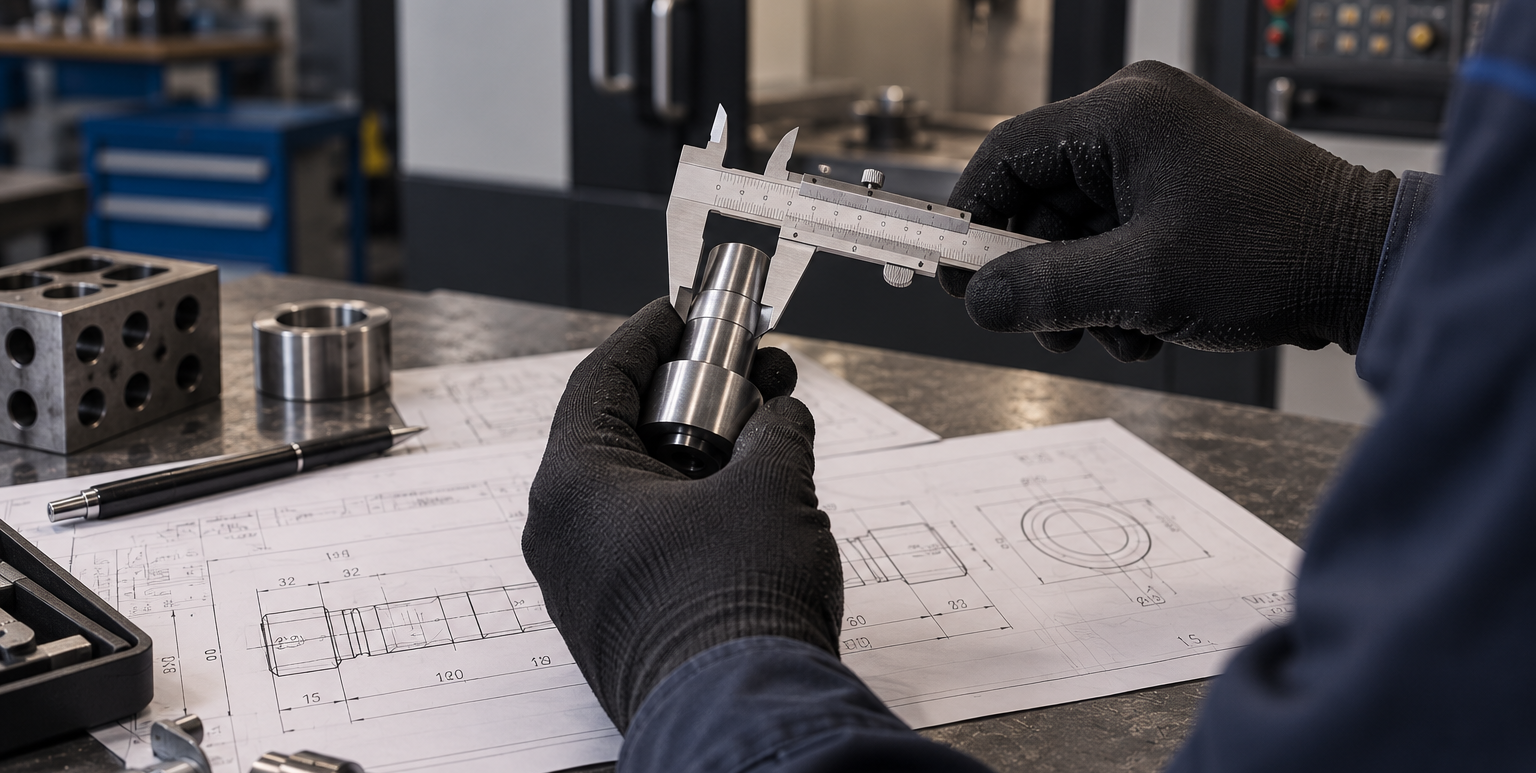
Detected errors and implemented changes should be recorded in process documentation or a setup log. Accumulated information reduces repeat setup time and helps prevent similar deviations when manufacturing subsequent batches.
CNC setup technician qualification grades and career growth
For this profession, qualification requirements provide grades from 4 to 8. A higher grade is associated with performing more complex setup work, broader responsibility, and greater independence when working with equipment. In practice, professional competence develops not only through years of experience, but also through work with different CNC systems, machine types, and technological tasks.
Career development can follow several directions:
- mastering multi-axis and combined machines;
- moving into machining program preparation and CAM systems;
- moving into a role as a machining process engineer;
- developing in service and commissioning work;
- progressing to production-area supervisor or automation specialist.
The value of an experienced setup technician is particularly evident in production environments with frequent product changes, where equipment must be prepared quickly for a new operation, setup time reduced, and a stable result achieved with a minimum number of trial parts.
How much does a CNC setup technician earn in Ukraine?
Pay levels depend on the region, experience, work schedule, equipment complexity, and level of responsibility. Ukrainian job listings in 2026 include offers of approximately UAH 25,000-60,000 per month. For specialists with experience in setup and programming of more complex equipment, ranges of UAH 50,000-70,000 and UAH 60,000-80,000 can also be found. Individual offers may fall outside these ranges.
However, comparing vacancies by salary alone is not entirely accurate. In one company, a setup technician may receive a complete technological process and machining program, while in another they may also edit programs, select tools and fixtures, train operators, or be responsible for a larger machine fleet. Income is also affected by shift patterns, region, production volume, and experience with specific CNC systems.
Therefore, when evaluating a vacancy, the stated salary should be compared with the actual scope of responsibility and required level of independence. Working with five-axis, turn-mill, and other complex machines usually requires a broader range of competencies than operating already configured equipment with repetitive production.
How to become a CNC setup technician and gain practical experience
To become a CNC setup technician, theoretical training should be combined with practical work on real equipment. A programming course alone is not enough: the specialist must work with an actual machine, fixtures, cutting and measuring tools, coordinate systems, and machining technology.
A possible learning sequence is:
- study the fundamentals of metalworking and machine construction;
- learn to read engineering drawings, tolerances, and technological documentation;
- master measuring tools and the principles of workpiece location and clamping;
- understand the structure of machining programs and basic CNC commands;
- gain practical skills in tool installation, measurement, and setup;
- learn to set work coordinates and tool offsets, perform trial cycles, and evaluate the result of the first machining operation;
- progress to more complex machines and technological tasks under the guidance of an experienced mentor.
Practical experience is especially important at the beginning because it helps build an understanding of the relationship between the machining program, cutting tools, fixtures, material, and the actual machining result.
Where to study to become a CNC setup technician in Ukraine
Professional training can be obtained at vocational education institutions that teach the setup of numerically controlled machines and manipulators. In the Ukrainian system, the profession “Setup technician for machines and manipulators with program control” has code 7223 and provides corresponding vocational qualification training.
Another option is to study at a technical college or obtain higher education in a related engineering specialty. For those who plan to develop further in manufacturing technology, process design, or production-area management, the G9 “Applied Mechanics” specialty may be suitable. Depending on the educational institution, programs within this field may be related to manufacturing technologies, equipment, mechanical systems, and mechatronics.
Additional options include courses focused on specific CNC systems and training directly at a manufacturing company. When choosing a training program, it is important to evaluate not only its title, but also the availability of functioning equipment, the amount of practical training, work with measuring instruments, drawing interpretation, and real machine setup operations.
When selecting an educational institution, it is useful to find out whether students have access to operating machines, how much time is allocated to practical classes, and whether internships in industrial companies are available. Practical training is especially important for setup technicians because professional skills are developed through real changeovers, measurements, trial runs, and analysis of technological situations.
Why CNC setup affects the stability of part production
The machine executes programmed commands, but the final result depends on correct workpiece location, tool installation, work coordinates, offsets, and machining parameters. Even a correct machining program cannot compensate for an incorrect work offset, unreliable workpiece clamping, or an incorrectly entered tool offset.
For a manufacturing company, high-quality setup means lower material losses when launching a new batch, reduced non-productive downtime, and stable production of acceptable parts. The setup technician's role is particularly important in production environments with a wide range of products, where machines must frequently be reconfigured for new parts.
At the same time, the setup technician works with related specialists and must understand the limits of their own responsibilities. Questions concerning machining technology are resolved together with the process engineer, complex faults in the CNC system, drives, and other machine units require service specialists, while certain quality-control tasks may be transferred to the metrology department.
When new equipment is introduced into production, not only the machine's specifications matter, but also correct commissioning, personnel training, and ongoing technical support. TECHNICAL CLUSTER LLC, the official representative of WIA Machine Tools in Ukraine, supports equipment supply projects by helping select the model and factory configuration according to the technical specification, organizing delivery and installation, commissioning the machine, training personnel, and providing service support. This approach helps prepare both the equipment and employees for operation under the conditions of a specific production area.